


Overheard
Only two things will survive nuclear annihilation: cockroaches and the Adobe Reader updater.

@crimmins
crimmins
I’m impressed so far with the redesign of the Boston Globe website. The new layout is clean and easy to use, but best of all it now features responsive design so that the page display adapts to whatever device you view it on. I have only casually browsed the site so far, but I have tried it on my notebook, smartphone, and color ebook reader. (OK, that’s a ThinkPad, Droid Incredible, and Nook Color.) The stories are easy to find and follow on all devices, and site performance seems good (unlike the old boston.com sluggishness).
I currently subscribe to home delivery of the Sunday Boston Globe, and every time the paper is wet, missing, or late I think seriously about canceling. However, access to the new online Globe is now included with the subscription. I think this new redesign may be enough to keep me subscribed.
On Monday, May 23, I attended the Boston edition of the MadCap Software roadshow (actually, it was held in Dedham). The event is a full day of high-level training and show-and-tell about MadCap’s Flare.
MadCap founder Mike Hamilton presented, along with MadCap support guy Neil Posner. Also on hand was a famous local Neil: Flare guru Neil Perlin (I remember when Neil was a RoboHelp guru!). The presentations covered a nice mix of the latest trends in technical communications, plus new and key features of Flare. The Flare stuff never got too salesy, which I appreciated.
One of the highlights of the day for me was Mike’s CSS presentation. He gave an excellent explanation of how they work, and his handouts have become a part of my reference library.
The latest version of Flare includes a QR code generator. While this feature is very cool, I do wonder if QR codes will stick around or if they are just another fad. I have used them in several documents for a client, but I haven’t heard how successful they are in the wild. However, Neil Posner’s demonstration was top notch.
I enjoyed the MadCap Roadshow and feel like I got my money’s worth. I’m not sure it’s an event I need to attend every year (especially on my own dime) but this year, with the release of Flare 7, was a good one to catch.
Authoring tool Flare, from MadCap Software, is one of my favorite content development applications. It’s right up there with FrameMaker, and might even take the number one spot — if I ever got a chance to use it. Flare’s popularity is growing, but I haven’t had many clients or employers that have adopted it as their authoring tool.
It used to be common for technical writers to specialize in either print or help. The growth of web publishing helped blur the lines between the two disciplines, and I think it’s safe to say that the best contemporary tech communicators have embraced the mode of creating content (you know, writing) that can be published in any number of media: print, online, desktop, and mobile. This sort of multi-channel publishing is what Madcap Flare does best.
I’m a big believer in “use it or lose it”, and I don’t want my Flare skills to atrophy so I am looking forward to attending MadCap’s Roadshow when it comes to Boston in May. I’ll post a report here after the event.
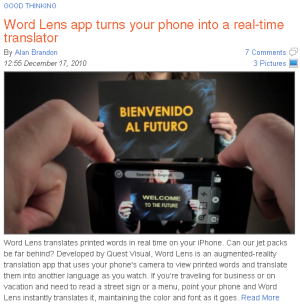
I wrote an article in Gizmag about Quest Visual’s Word Lens app, an augmented-reality translator that uses your phone’s camera to view printed words and translate them into another language as you watch in real time.
According to reviews the app is not fully baked yet, but it seems to be off to a great start.